Electric Kettle Manufacturing: Key Material & QC Standards for Global Wholesale Markets
Electric Kettle Manufacturing: Key Material & QC Standards for Global Wholesale Markets
For global wholesale buyers, sourcing electric kettles from overseas manufacturers brings recurring risks: non‑compliant raw‑material batches, hidden safety defects, and shipment hold‑ups caused by mismatched regional regulatory requirements. When conducting OEM and ODM procurement, material selection and quality‑control systems directly determine whether products can legally enter EU, North America, Southeast Asia and other mainstream markets. This article breaks down core manufacturing materials, mandatory QC checkpoints and cross‑market compliance requirements for B2B importers, hotel procurement teams and private‑label brand operators.

1. Core Raw‑Materials for Electric Kettle Production
Stainless steel remains the most widely adopted material for electric‑kettle production, capturing more than half of global market revenue share in 2025. Different material grades directly affect food‑contact safety, corrosion resistance, product service life and end‑user satisfaction.
1.1 Food‑Grade Stainless Steel (Inner Tank)
304 stainless steel is the industry mainstream, accounting for roughly 80% of B2B wholesale electric‑kettle transactions. It delivers stable corrosion resistance under daily boiling‑water conditions with balanced cost‑performance, widely used for household and standard‑spec hotel models. All water‑contact surfaces must satisfy food‑contact substance migration rules set out in EU 1935/2004 and US FDA 21 CFR.
316L stainless steel represents the premium tier. Molybdenum additives improve resistance against hard‑water and chloride‑rich tap‑water corrosion. It suits high‑frequency commercial scenarios, premium private‑label collections and high‑end hotel projects, though raw‑material costs are noticeably higher.
An important sourcing reminder: outer‑shell material does not equal inner‑tank material. Many low‑cost products use ordinary steel for outer housings while only the water‑contact liner uses food‑grade stainless steel. Buyers should request material‑test reports specifically for wetted components instead of judging quality only by surface appearance.
1.2 Plastic Components (Lid, Handle, Sealing Ring, Water‑window)
All plastic parts touching water or steam need heat‑resistant, BPA‑free food‑contact resin. For European market shipments, plastic components must comply with EU Regulation 10/2011. For United States orders, materials need FDA‑recognized food‑contact‑substance clearance.
Low‑grade plastic tends to generate strange odors, discoloration and chemical migration after repeated thermal cycles from boiling water, which triggers consumer complaints and official product recalls.
1.3 Thermostat and Heating Assembly
The thermostat functions as the core safety component of electric kettles. Export‑oriented Chinese factories mostly adopt well‑known thermostat brands such as Strix and Otter. A dual‑protection mechanism combining thermostat and non‑resettable thermal fuse is required. Under dry‑boil fault conditions, power should be cut off rapidly to avoid fire hazards.
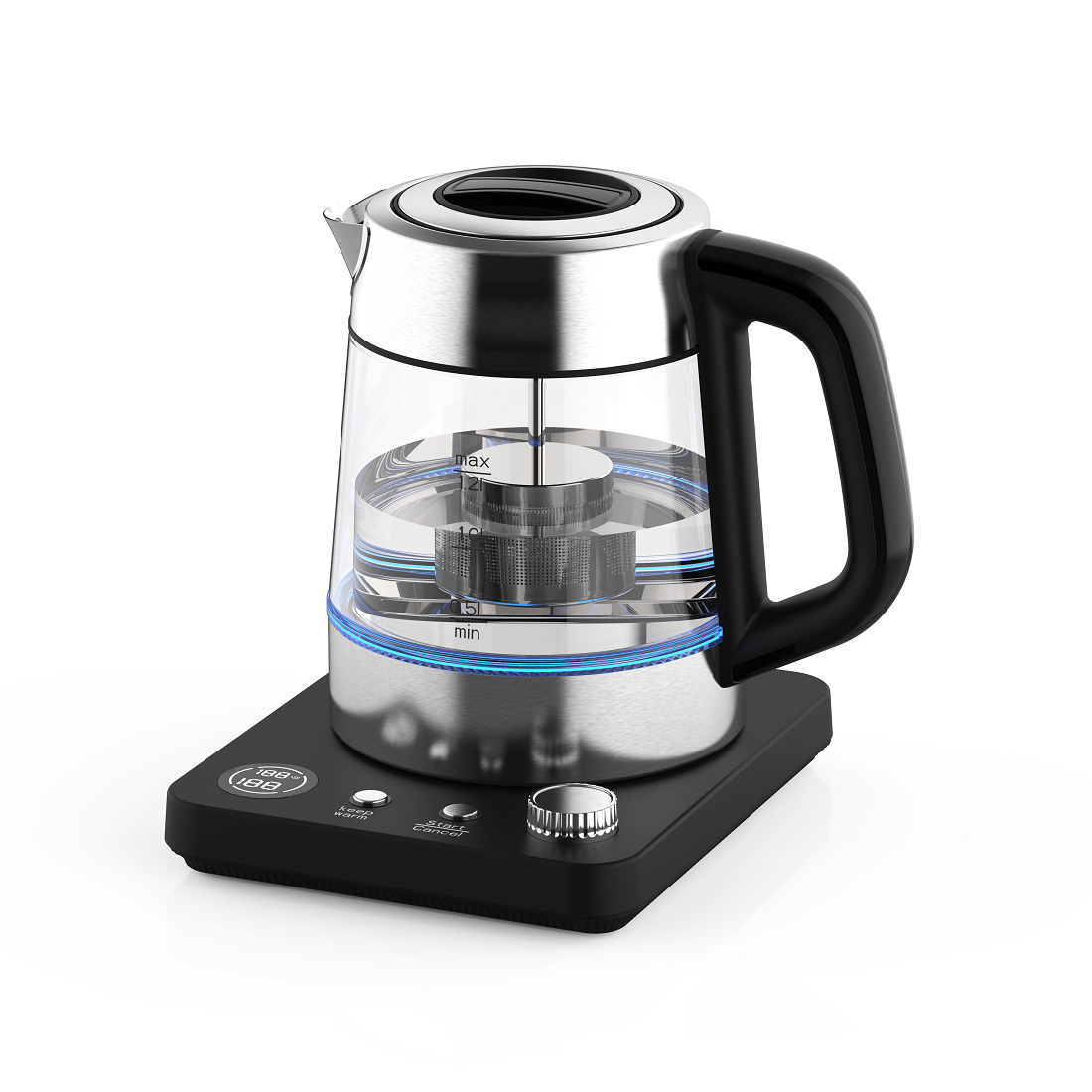
1.4 High‑borosilicate Glass (Glass‑body Models)
High‑borosilicate glass offers strong thermal‑shock resistance for glass‑type electric kettles. Wholesale purchasers should ask suppliers to provide third‑party test reports covering thermal‑cycle stability and heavy‑metal migration for glass inner surfaces.

2. Mandatory QC Testing for Global Wholesale Orders
The global baseline safety standard for liquid‑heating household appliances is IEC 60335‑1:2022 paired with IEC 60335‑2‑15:2024, which forms the foundation for most national certification schemes worldwide. Factories producing for overseas wholesale must implement multi‑stage quality control: incoming‑material inspection, semi‑finished‑product testing and finished‑product ageing validation.
2.1 Incoming‑Material Quality Control
Manufacturers shall verify certificates of analysis (COA) for stainless‑steel coils, plastic granules and thermostat assemblies. Random third‑party laboratory testing for food‑contact heavy‑metal migration should be arranged. Non‑conforming batches must be rejected before mass‑production launch to prevent large‑order losses.
2.2 Electrical‑Safety Performance Testing
Following IEC 60335‑2‑15 test clauses, key electrical‑safety items include: ‑ Hipot withstand‑voltage test; no insulation breakdown allowed ‑ Leakage‑current measurement under normal operating conditions ‑ Ground‑continuity resistance verification for metal housings ‑ Dry‑boil protection test to confirm thermal‑fuse activation under fault modes
2.3 Durability and Mechanical QC Items
‑ Thermal‑cycle ageing test simulates long‑term real‑world boil‑cool usage cycles ‑ 0.5J steel‑ball impact test assesses housing mechanical strength ‑ Handle fatigue cycling test and finished‑product six‑face drop test simulate logistics‑transport damage risks ‑ Stability test on tilted surface prevents tipping‑over hazards when fully filled
2.4 Pre‑shipment Inspection
Wholesale bulk orders adopt AQL‑based random sampling. Inspectors check water leakage, lid‑sealing performance, auto‑shut‑off temperature accuracy, surface scratches and assembly defects before cargo release.

3. Regional Compliance Requirements for Major Export Markets
A common mistake among new‑to‑export buyers is confusing appliance‑safety certification with food‑contact‑material certification. These belong to separate regulatory systems, and one certificate cannot replace the other.
‑ European Union: CE‑LVD certification based on EN 60335‑2‑15, CB certificate acceptable for many‑country conversions. Food‑contact materials follow EU 1935/2004 and EU 10/2011; German retail channels commonly require additional LFGB testing. Environmental rules include RoHS 3 and WEEE‑EPR packaging obligations. ‑ United States & Canada: UL or ETL electrical‑safety certification. Food‑contact parts comply with FDA 21 CFR. Products sold in California need Proposition 65 hazard warnings where applicable. ‑ India: Mandatory BIS certification effective March 2026, together with local food‑contact‑material standards and India RoHS. ‑ Southeast Asia: PSB, TISI or other national certifications built upon the IEC 60335 standard, plus local food‑contact regulations and regional MEPS energy‑efficiency requirements.

4. Practical Sourcing Checklist for Wholesale & Private‑Label Buyers
Before sample confirmation and mass‑order placement when auditing Chinese electric‑kettle manufacturers, request the following documents:
- Raw‑material COA covering all water‑contact internal components
- Third‑party‑lab migration‑test reports for food‑contact materials
- Valid electrical‑safety certifications matching target‑market requirements
- Internal‑factory QC workflow documents covering incoming‑material checks, product‑ageing and pre‑shipment inspection
- Qualification documentation for thermostat component suppliers
Poor material governance and incomplete QC workflows may result in customs detention, product recalls and irreversible brand‑reputation damage. For high‑value wholesale projects, prioritize factories with in‑house laboratory capabilities rather than making purchasing decisions based purely on unit‑price comparison.

Conclusion
Within global electric‑kettle wholesale business, material grade and compliance‑oriented quality‑control form the foundation of stable OEM cooperation. Reasonable selection between 304 and 316L stainless steel, strict management of food‑safe plastic components, qualified thermostat hardware and rigorous IEC‑standard testing together determine whether goods can smoothly clear import procedures. Buyers should avoid over‑emphasis on low unit price and focus on verifiable, traceable test reports and certification documents to mitigate cross‑border‑trade risks.
How B2B Buyers Evaluate Electric Kettles: Sourcing Checklist for Retail & Private‑Label Projects
Rising Demand for Temperature controlled Electric Kettles: Opportunities for Private label Brands